For
20
pers.
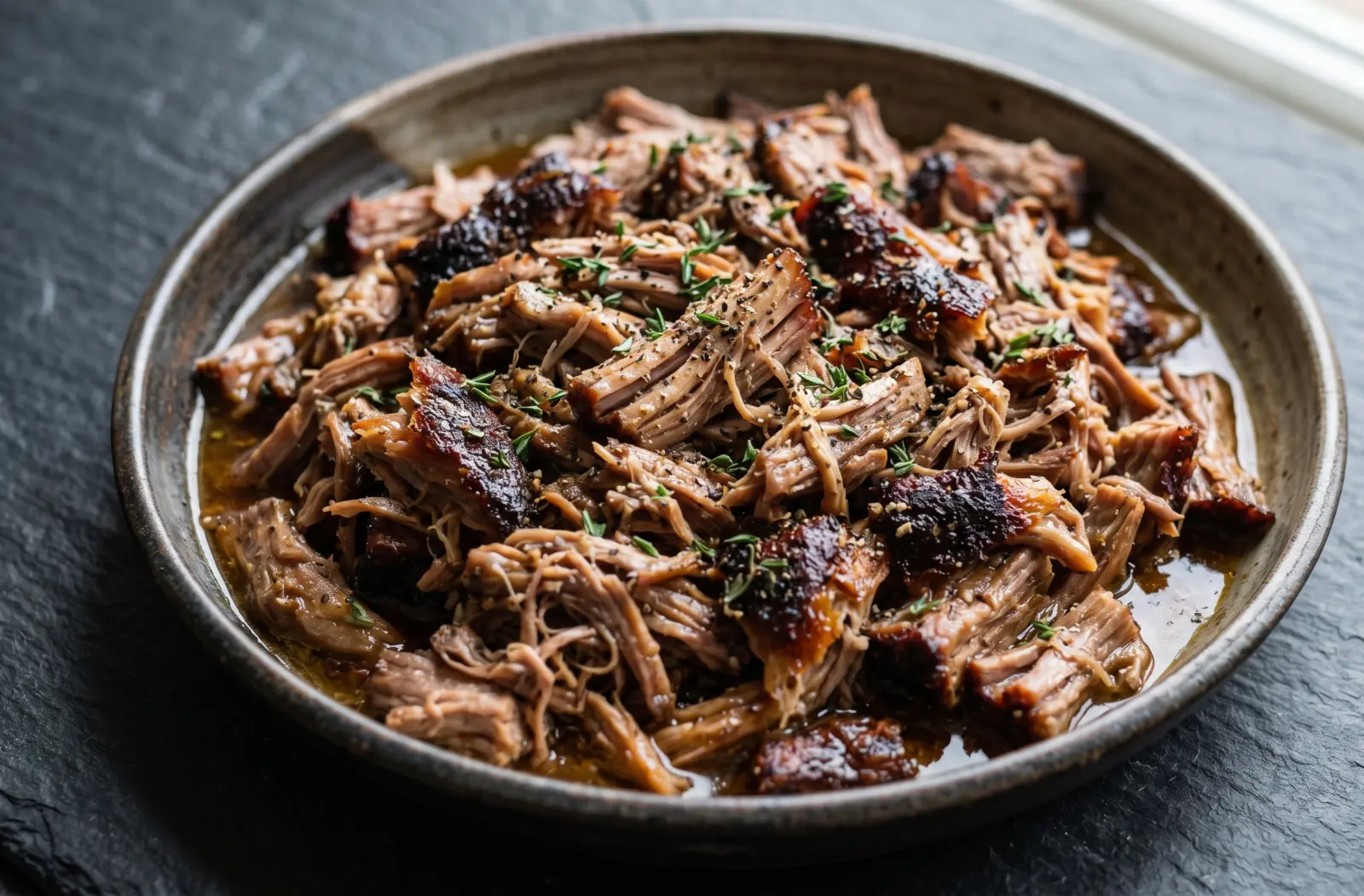
French-Style Kamado Pulled Pork
A 'Low and Slow' masterclass. This French-style interpretation breaks away from overly sweet marinades to focus on the purity of the product: the alchemical transformation of collagen into melt-in-the-mouth gelatin. The slow wood smoking on the kamado elevates the raw meat, creating a deeply savory crust (the 'bark') through a prolonged Maillard reaction.
Prep : 45 min
Total time :
14 h
Required Equipment
Gastronomic Protocol
Click to cross outMake ahead (Mise en place & Cooking)
1
Step 1
Trimming and prep: Trim the upper fat cap of the shoulder to leave only about 5 millimeters. This allows the fat to render during cooking while letting the seasoning penetrate the meat. In a mortar, crush the coriander seeds and strip the fresh thyme leaves. Mix with the fleur de sel, black pepper, and smoked paprika. Coat the meat with this rub, massaging firmly. The salt will draw out surface moisture through osmosis, and then this natural brine will be reabsorbed into the fibers, seasoning the meat thoroughly.
2
Step 2
Lighting and stabilization: Prepare your kamado for indirect cooking (with the heat deflector). Stabilize the temperature at exactly 110°C (230°F). Add a few large chunks of beech or apple wood to the coals. Place the shoulder on the grate. During the first 3 hours, nitric oxide from the burning wood will react with the myoglobin in the meat to create the famous 'smoke ring', that characteristic pink ring just beneath the crust.
3
Step 3
Bark formation and Spritzing: After about 4 hours, the Maillard reaction has taken effect and a beautiful dark crust (the bark) begins to form. In a spray bottle, mix the mineral water and apple cider vinegar. Lightly spritz the surface of the meat every hour. This moisture captures smoke better and slightly delays surface cooking, preventing the crust from burning while adding a subtle acidity that balances the fat.
4
Step 4
Pushing through the 'Stall': When the internal temperature of the meat reaches around 72°C (160°F), the temperature plateaus. This is the 'stall', caused by evaporative cooling of the water within the meat. Tightly wrap the shoulder in a double layer of butcher paper (or parchment paper then aluminum foil). Return to the kamado until the internal temperature reaches 95°C (203°F). It is during this tightly sealed phase that the connective tissue (collagen) literally melts into silky gelatin.
5
Step 5
Resting: Remove the shoulder from the kamado without unwrapping it and place it in a closed insulated cooler (without ice) for at least 2 hours. This step is non-negotiable. It allows the muscle fibers, contracted by the heat, to slowly relax. The cooking juices, concentrated in the center, will then redistribute evenly throughout the piece of meat, ensuring an extremely juicy pulled pork.
Just before serving
Step 1
Unwrap the meat into a large deep dish to collect absolutely all the gelatinous juices. Remove the shoulder blade bone: it should slide out of the meat with zero resistance, the ultimate sign of perfect cooking. Using two forks or meat claws, coarsely shred the meat, taking care to thoroughly mix the highly flavorful 'bark' pieces with the tender inner meat. Drizzle the shredded meat with its own cooking juices, plate generously in the center of the table, and let your guests serve themselves this raw and beautifully textured marvel.
Nutritional Values
per pers.580
Kcal
52g
Prot.
2g
Carbs
38g
Fat
Chef's Tip
The crucial step is pushing through the 'stall' (the internal temperature plateau around 70°C/160°F where evaporation cools the meat and stalls cooking). Wrap the shoulder tightly at this stage to stop evaporation and force the collagen to melt. Although this recipe uses a massive 6kg piece, essential to guarantee thermal inertia and optimal kamado results without drying out, it will generously feed your 4 guests while leaving sumptuous leftovers that freeze perfectly in their juices.
Wine Pairing
The melted fat of the shoulder and the empyreumatic notes from the long smoke demand a fleshy red wine with good acidity to cleanse the palate. A Northern Rhône Syrah, such as a majestic Côte-Rôtie or a Saint-Joseph with peppery notes, will create a perfect aromatic resonance with the spiced rub.
Did you like this recipe?
Your review helps other cooks discover it.